 Office Clearance Colindale — Health & Safety Policy
Scope: This Health and Safety policy sets out the responsibilities and procedures for staff, contractors and operatives engaged in office clearance and waste removal within our rubbish company service area. It applies to all activities related to office clearance, waste clearance Colindale, commercial rubbish collection and associated vehicle operations, ensuring safe, efficient and compliant operations across sites and customer premises.
 This policy is designed to manage risks without unnecessary local legal detail. It reflects best practice for a waste removal and clearance firm operating in an urban service area and is intended to be read alongside specific site risk assessments and operational procedures. All employees must be familiar with these requirements and their role in maintaining a safe workplace for colleagues and clients.
Responsibilities and Management
 The senior management team are responsible for setting and maintaining health and safety standards. Managers will ensure that robust training, supervision and resources are provided. Staff are required to follow safe systems of work, report hazards and incidents promptly, and participate in relevant training. Contractors and subcontractors engaged for office clearance tasks must demonstrate equivalent safety standards before work commences.
Risk assessments: Regular and task-specific risk assessments must be carried out for each office clearance project. These assessments identify hazards such as manual handling, sharp objects, asbestos risk, electrical waste, and hazardous materials. Control measures include use of correct lifting techniques, provision of suitable PPE, correct segregation of waste streams and safe vehicle loading practices.
Training and Competence
All operatives will receive induction training covering rubbish collection procedures, manual handling, vehicle safety, and emergency protocols. Ongoing refresher training ensures competence in handling bulky office furniture, sensitive documents, and recyclable materials. Supervisors will assess competency and provide on-the-job coaching to reduce incidents and near misses.
Personal Protective Equipment (PPE): Appropriate PPE must be available and worn at all times when carrying out clearance tasks. This includes gloves, high-visibility clothing, protective footwear and eye protection where required. PPE requirements will be specified in task risk assessments and must be enforced by supervisors.
Safe work practices: Operatives must follow standard operating procedures for loading, securing and transporting waste. Vehicles should be inspected daily, and loads secured to prevent shifting. Manual handling aids such as trolleys and lifting straps should be used to reduce strain. When handling confidential materials, secure containment and transfer procedures are mandatory to protect client data and ensure compliance with information security obligations.
Emergency procedures: Clear emergency arrangements must be in place for medical incidents, spillages, fire and vehicle incidents. Staff must know how to summon assistance, use spill kits and apply basic first aid. A named responsible person will maintain records of incidents and ensure corrective actions are implemented.
Vehicle and Traffic Safety: Vehicles used in office clearance must be maintained to a high standard, with routine inspections and servicing. Drivers will follow safe driving policies, load and unload in safe locations where possible, and use assistants or banksmen when visibility is restricted. Special attention should be given to pedestrian safety in and around office premises.
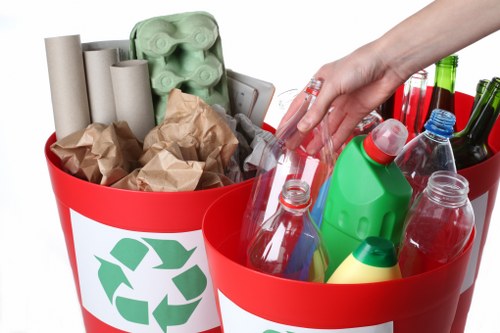
Waste segregation and disposal: Clear procedures ensure that recyclable, hazardous and general waste are segregated at source. Items such as batteries, fluorescent tubes, IT equipment and hazardous materials must be identified and managed using approved disposal routes. Documentation for waste transfers should be completed to support traceability.
Site-specific controls: Prior to commencing work at any office premises, a site appraisal will identify access routes, lift usage, stair hazards and any restricted areas. A method statement will outline how the work will be carried out safely, including the use of lifts, stair protection, and the timing of activity to minimise disruption and risk.
 Incident reporting and investigation are integral to continuous improvement. All accidents, near misses and dangerous occurrences must be reported immediately and recorded. Investigations will identify root causes and actions to prevent recurrence. Lessons learned will be shared with teams to reinforce safe behaviours.
 Health surveillance and welfare: Where tasks present repetitive strain, dust exposure or other occupational health risks, appropriate health surveillance will be provided. Staff must have access to welfare facilities, hydration, rest breaks and support for mental wellbeing. The organisation recognises that a healthy workforce is a safer workforce.
Monitoring and review: This policy will be reviewed at regular intervals and whenever there is a significant change in operations. Key performance indicators such as incident rates, training completion and vehicle inspection compliance will be monitored. Audit and spot checks will verify adherence to standards and identify opportunities for improvement.
Commitment: The company is committed to providing a safe working environment for all employees and third parties affected by our operations. We will allocate sufficient resources to implement this policy effectively and ensure that it remains relevant to the scope of our office clearance and rubbish removal services.
Implementation: Managers must ensure the policy is communicated, understood and applied. Workers are expected to cooperate and take reasonable care for their own safety and that of others. Continuous engagement, training and a proactive approach to hazard management will underpin safe and reliable waste collection and office clearance services across our service area.
Final note: This Health and Safety policy provides a framework for safe operation during office clearance activities and associated rubbish collection. It emphasises risk mitigation, staff competence, clear procedures and the use of appropriate equipment to protect people, property and the environment.
